..
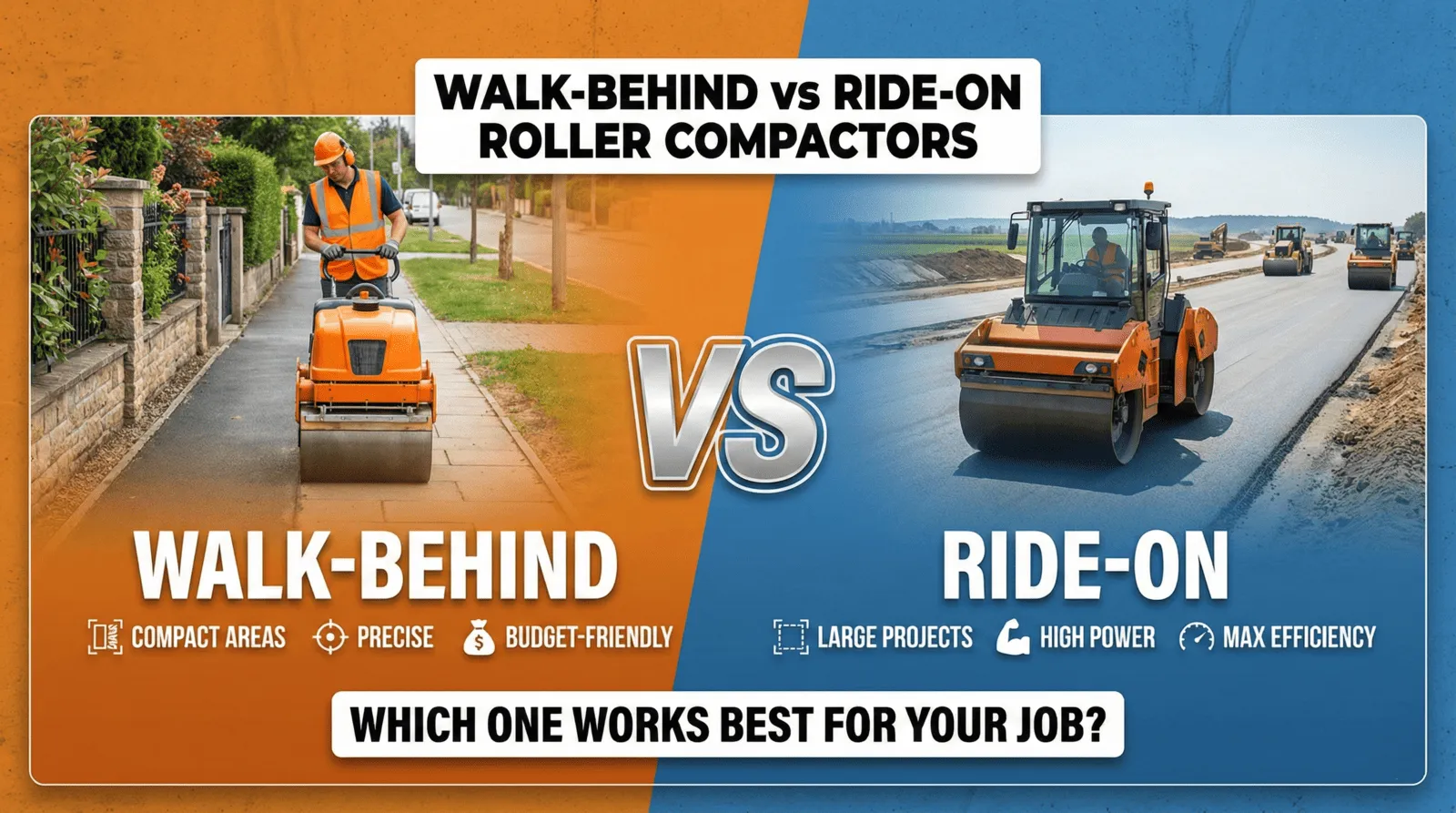
Walk-Behind vs Ride-On Roller Compactors
Choosing the right machinery is key to the success of any road construction or soil compaction project. The issue of walk-behind vs. ride-on roller compactors is something that every site manager and contractor will have to deal with sooner or later.
The decision is not only about the size of the machines; it also concerns the efficiency, budget, site constraints, and the specific density of the material you are working with. Whether you are paving a giant highway or compacting a very narrow trench for utilities, knowing the differences between these two types of rollers will be of enormous help.
At Roller Compactor, we are here for you to make the right choices, and that is why this guide will give you all the details on machine specifications as well as their pros and cons to help you choose the one that fits your needs.
Please note that these are just suggestions, and you can customize your home theater design based on your personal preferences and available space.
Why Compaction Equipment Selection is a Major Decision
Once we start to elaborate on the differences, we first need to realize why the decision is a significant one. Compaction involves increasing the particle density of soil or asphalt by pushing out the air trapped between soil particles/aggregate particles.
Picking a machine that doesn’t have enough weight will result in your structure failing, potholes developing, and foundations sinking. While a massive ride-on roller being used to compact soils in a small delicate site can damage the adjacent structures and is unnecessary.
Safety Compliance: Highly secure job sites may restrict the type of equipment to be used for safety purposes.
Structural Integrity: Good compaction makes the material strong enough to handle the load placed on it without settling.
Cost Effectiveness: Picking the appropriate machine can help you avoid over compaction (wasting time/fuel) and under-compaction (price of rework).
Deep Dive: Walk-Behind Roller Compactors
Walk-behind rollers, aka pedestrian rollers, play a vital role in the precise compaction of soil. They efficiently deliver the required compaction of soil to fine detail at the job site situated in areas or spots that are relatively smaller and more difficult to reach than the ride-on roller.
The operator controls them using a handle or a remote control while walking behind the machine. In the walk-behind vs. ride-on roller compactors showdown, these units hold their own in tight spaces.
Better maneuverability: The compact size of these machines allows them to fit through narrow gates, work along building foundations, and make tight corners that a ride-on roller could not access.
Enhanced Safety for Trenches: The operator can remotely control the equipment and thus stay out of harm’s way if the area inside the trench is risky.
Enhanced Safety for Trenches: They are cheaper to buy, consume less fuel, and thus have lower operating costs, making them highly suitable for small jobs where the budget is a concern.
Landscaping and hardscaping: Sidewalks, patios, and retaining walls are all examples of where sub-bases need to be compacted but large machinery is not an option due to their potential to damage the surroundings.
Deep Dive: Ride-On Roller Compactors
On the other hand, ride-on roller compactors are at the other end of the spectrum. They are like the beasts of the construction world and are necessary for large-scale infrastructure projects. The name itself tells you that the operator can sit in a cab or on a seat on top of the machine. When you compare walk-behind vs. ride-on roller compactors, ride-on models take the trophy for speed and power.
Main Benefits of Ride-on Rollers
Strongly Perform High Compaction: A roller compactor is a type of heavy machinery that is used for compacting soil or different surfaces to make them hard and smooth. The ride-on roller compactors come with a high static and vibratory forces that allow them to compact the road base with thicker lifts (layers) and in fewer passes, which is a critical factor in the case of highways having density specs that are very strict.
Keep the Operator Comfort and Less Fatigue: If the operator work for day-long, then the ergonomic seating (sometimes with the climate control in the enclosed cabs) is a huge help in reducing operator fatigue (to greatly) compared to walking behind a vibrating machine for hours.
When Working on Big Areas, Be More Efficient: Because of their drum which is wider and their travel speed which is faster, a ride-on roller can cover the widest area possible in the least time. They even say that a project can be done within two days if a foot machine is used. Therefore, using ride-on rollers may be considered as one of the key factors to projects being on schedule.
Ideal Applications for Ride-On Rollers:
Highway and Road Construction: This is the typical case where ride-on rollers are used for thousands of miles of laying asphalt or for compacting the road base, where the elements speed and consistency are very important.
Large Parking Lots: Parking lots for commercial and industrial purposes require a flat surface to be laid which can endure the heavy truck traffic. This can be achieved by using the heavy static weight of ride-on rollers.
Airport Runways: Projects such as airport runways are so huge that they require hard compaction to be done throughout the entire surface with only heavy-duty ride-on rollers being able to achieve such compaction densities consistently.
List Style
- Comparison of Two Roller Compactors: Walk-Behind vs Ride-On Roller Compactors
- Making the right purchase or rental decision takes into consideration certain factors, which we will discuss. It is hardly ever so that one is better than the other, but which is “better for you” at the present moment.
- 1. Project size and site challenges
- In a nutshell, the size of your site will largely determine the type of machine you use. Imagine the scenario of a residential backyard with a gate size of 40 inches; clearly, a ride-on roller is out of the question.
- However, in the case of a 10-mile road, a walk-behind roller would take weeks to complete what a ride-on could accomplish within days.
- Narrowest access point: If you have less than 48 inches, then your choice of machine is limited to the walk-behind roller.
- Area coverage: Generally, walk-behind rollers are good for small spaces up to 2,000 square feet, whilst ride-on rollers gain efficiency as the size increases beyond 5,000 square feet.
- Surface conditions: A steep slope would be risky for a ride-on roller because of its high center of gravity; to be safe, remote-controlled walk-behind rollers might be used there.
Walk-Behind vs Ride-On Roller Compactors: FAQs
Do walk-behind rollers compact asphalt well?
Walk-behind asphalt rollers made particularly for this task are very efficient. Dual smooth drums plus water sprinklers to make sure hot asphalt doesn’t stick to the drum are some of these type of machines’ features. Besides driveways, biking paths, and pothole repair, these machines are spot-on for such uses. They are incapable of generating enough pressure needed by high traffic roads however.
Comments
Add a Review
Your email address will not be published. Required fields are marked*

americanskidsteer@gmail.com
How???